Introduction to Surface Area of Scoops
A documented procedure for surface area determination of dispensing scoops helps ensure that the calculation is performed consistently, recorded accurately, and reviewed appropriately. The method should account for the scoop’s actual geometry, including the bowl, inner and outer surfaces, and handle where applicable.
What is Surface Area of Scoops?
Surface area determination is the process of calculating the total area of the relevant surfaces of a dispensing scoop. Depending on its design, a scoop may consist of a curved bowl, a flat or rounded bottom, side walls, and a handle.
For cleaning-related assessments, it is important to distinguish between:
- Product-contact surface area: Surfaces that directly contact the pharmaceutical material.
- Non-product-contact surface area: External surfaces that do not normally contact the material but may be included in a defined assessment.
- Total assessed surface area: The sum of the surfaces included within the documented scope of the calculation.
Why Surface Area of Scoops are required?
Determining the surface area of dispensing scoops may support several pharmaceutical quality activities:
- Establishing the product-contact area of scoops used for material dispensing.
- Supporting cleaning validation calculations when justified by the approved cleaning validation strategy.
- Assessing equipment surface areas for residue evaluation.
- Maintaining consistent equipment records.
- Comparing scoops of different capacities and designs.
- Supporting risk assessments for shared or multiproduct manufacturing equipment.
Importance in Pharmaceutical Manufacturing and GMP
Dispensing scoops are often used for handling different materials, and their cleaning requirements depend on their intended use, design, and potential product-contact risks.
From a GMP perspective, the procedure should ensure that:
- The scoop is uniquely identified.
- The measurement method is appropriate for the scoop’s shape.
- All relevant surfaces are considered consistently.
- Calculations are checked and traceable.
- Records are reviewed and approved according to site procedures.
Regulatory and GMP Expectations
GMP principles emphasize equipment suitability, prevention of contamination, appropriate cleaning, and maintenance of reliable documentation.
Procedure for Determination of Surface Area of Scoops
Identification of the Dispensing Scoop
- Collect the dispensing scoop to be assessed.
- Verify its equipment identification number, if available.
- Record the scoop’s material of construction, nominal capacity, shape, and intended use.
- Confirm whether the calculation is intended to cover product-contact surfaces only or a wider defined area.
- Inspect the scoop for damage, deformation, sharp edges, or other features that could affect measurement.
Identification of Surfaces
Examine the scoop and divide its geometry into measurable sections.
Typical sections may include:
- Inner bowl surface
- Outer bowl surface
- Bowl bottom
- Side walls
- Handle, if included in the defined scope
- Joints, attachments, or other relevant surfaces
Avoid counting the same surface more than once. If the scoop has a curved or irregular bowl, use an appropriate measurement or estimation method rather than assuming that the entire bowl is flat.
Measurement of Dimensions
- Place the scoop on a stable surface.
- Measure the relevant dimensions using a suitable measuring instrument.
- For a scoop with a circular opening, record the diameter or radius as required.
- For an approximately rectangular or flat section, record the length and width.
- For a curved bowl, identify the geometry needed for the selected calculation method. If necessary, use a template, flexible measuring method, or suitable validated measurement technique.
- Record each measurement in the approved calculation sheet.
- Repeat measurements when necessary to confirm consistency.
Record dimensions in a consistent unit, preferably centimetres, before performing the calculation.
Calculation of Surface Area
Calculate the area of each identified section using an appropriate geometric formula. Add only those surfaces included in the defined scope.
Common formulas include:
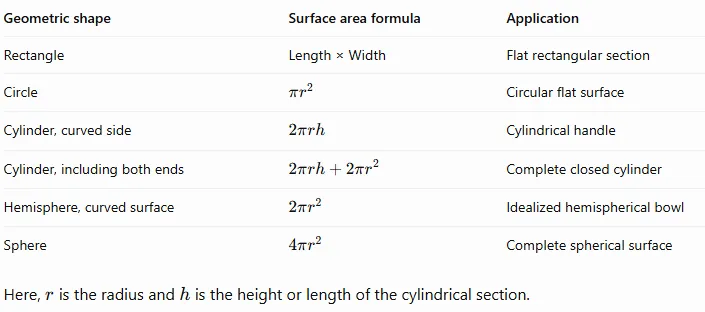
Here, r is the radius and h is the height or length of the cylindrical section.
These formulas apply only when the scoop’s geometry reasonably matches the stated shape. An actual dispensing scoop may have a shallow, oval, tapered, or irregular bowl. In such cases, use a suitable geometric approximation or an appropriate direct measurement method and document the assumptions.
Practical Example of area calculation
Surface Area of Scoop
Circular Part of Scoop
A1 = ½ π r2
Bowl Part
A2 = π rh
Handle Part
A3 = 2 π rh
Scoop 2 Kg
Bowl Part
R=8.5
H=25 cm
Handle Part
R= 1.25 cm
H= 10 cm
Divide this in to 3 parts for simplification
Circular part
A1 = ½ π r2
=1/2 X 3.14 X (8.5)2
= 113.4325
Bowl Part
A2 = πrh
3.14 X 8.5 X 25
667.25
Handle Part
A3 = 2 π rh
2X 3.14 X 1.25 X 10
= 78.5
TSA = A1 +A2+ A3
TSA = 860 cm2
Spatula Surface Area Circular type
Arc Portion = 2 π r h
2 X 3.14 X 2.75 X 8.5
= 146.795
Handle Part = (2 X L X W)
= 2 X 1.5 X 14.5
= 43.5
TSA = 146.795 + 43.5
TSA = 190.295
Spatula Surface Area Flat type
Handle Part = (2 X L X W)
2 X 8 x 6
= 96
Main Part = (2 X L X W)
2 X 31 X 2.5
= 155
TSA = 251
Common Mistakes During Determination of Surface Area of Scoops
The following errors can affect the accuracy of the calculation:
- Measuring only the opening: The opening area is not the same as the total surface area of the bowl.
- Ignoring curved surfaces: Applying a flat-area formula to a curved bowl can produce an incorrect result.
- Omitting the handle: The handle may need to be included if it falls within the defined assessment scope.
- Double-counting surfaces: Overlapping sections can lead to an inflated total.
- Using inconsistent units: Mixing millimetres and centimetres without conversion can produce substantial errors.
- Making undocumented assumptions: Treating an irregular bowl as a perfect hemisphere without justification may affect reliability.
Frequently Asked Questions (FAQs) for Surface Area of Scoops
1. Why is surface area determination of dispensing scoops important?
It provides documented information about the area of relevant scoop surfaces and may support equipment assessment, cleaning validation calculations, and contamination-control activities.
2. Should the handle be included in the calculation?
It depends on the purpose of the assessment. If the objective is to determine product-contact surface area, include only the surfaces defined as product-contact surfaces. Include the handle when required by the approved assessment.
3. Which unit should be used for surface area?
Square centimetres (cm²) are convenient for many dispensing scoops. The selected unit should be consistent throughout the calculation and clearly recorded.
Related Articles
Cleaning Validation and How to calculate MACO and sampling procedure