Introduction to Dosing Solution Preparation
Dosing solution preparation and calculation provide a systematic method for determining the required quantity of chemical and water before preparing a solution in a dosing tank.
The calculations should be based on the approved water treatment design, the actual chemical concentration stated on the supplier’s label or certificate, the required dosage, and the verified operating parameters of the dosing pump.
What Is Dosing Solution Preparation?
Dosing solution preparation is the process of measuring a specified quantity of a treatment chemical, dissolving or diluting it in a suitable liquid, and preparing the resulting solution for controlled addition to a water treatment system.
The chemical is generally prepared in a designated dosing tank and delivered through a dosing pump at a controlled rate.
Common chemicals used in pharmaceutical water treatment include:
- Sodium hypochlorite (NaOCl): Used for chlorination or disinfection where specified by the system design.
- Sodium metabisulphite (SMBS): Used as a reducing agent, including for removal of residual chlorine before sensitive downstream treatment stages.
- Sodium hydroxide (NaOH): Used for pH adjustment or other approved treatment applications.
- Antiscalant: Used to help control scale formation in membrane-based water treatment systems.
- Sodium hexametaphosphate (SHMP): A chemical sometimes used for scale control; it should not automatically be treated as interchangeable with every commercial antiscalant.
Why Is Accurate Dosing Required?
Accurate preparation and dosing are necessary to achieve the intended chemical treatment without introducing unnecessary risks.
The main benefits include:
- Maintaining the intended water treatment performance.
- Reducing the risk of excessive or insufficient chemical addition.
- Protecting reverse osmosis membranes and other sensitive equipment.
- Supporting consistent operation of the water treatment plant.
- Reducing chemical wastage and unnecessary solution disposal.
- Maintaining traceable preparation and consumption records.
- Supporting investigation of dosing deviations and abnormal water quality results.
GMP Considerations for Dosing Solutions
Chemical preparation should be performed under an approved procedure and in accordance with the design and operating requirements of the water treatment system.
Important controls include:
- Use the correct chemical and verify its identity, grade, concentration, and expiry or retest status where applicable.
- Confirm the required dosage and calculation basis before weighing or measuring the chemical.
- Use suitable, calibrated or verified measuring devices.
- Ensure that the dosing tank is clean and suitable for the chemical.
- Use appropriate personal protective equipment (PPE).
- Follow the approved sequence for adding the chemical and water.
- Verify the dosing pump setting and actual delivery rate.
- Record the preparation details, quantities, date, and personnel involved.
- Investigate abnormal dosing, unexpected consumption, or relevant water quality deviations according to site procedures.
Detailed Procedure for Dosing Solution Preparation
1. General Preparation Requirements
Before preparing any dosing solution, verify the following:
- The chemical name and required concentration.
- The approved dosage and water flow rate.
- The required operating duration.
- The dosing pump capacity and actual delivery rate.
- The dosing tank capacity and cleanliness.
- The availability of suitable water for solution preparation.
- The required PPE and chemical-handling precautions.
The quantities given in this article are examples based on the supplied procedure. Confirm them against the approved plant-specific calculation and actual chemical specifications before use.
2. Calculation Formula for Dosing Chemicals
The source procedure uses the following formula for estimating the required chemical quantity:
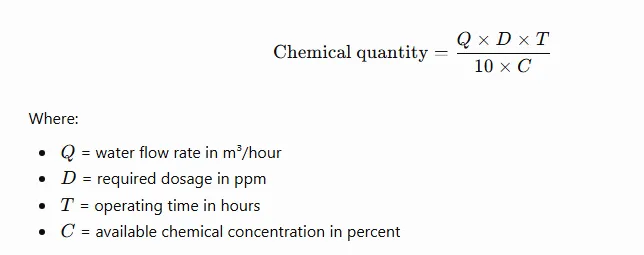
The formula gives a result in litres for liquid chemicals or kilograms for solid chemicals under the calculation assumptions used in the source procedure. Its applicability must be confirmed for the particular chemical, including whether density, assay basis, or other conversion factors are required.
Important: For sodium hypochlorite, the available chlorine concentration must be verified. For solid chemicals, use the actual assay or purity specified for the material.
3. Sodium Hypochlorite (NaOCl) Solution
Sodium hypochlorite may be used for chlorination or disinfection in the relevant stage of a water treatment system.
The amount required depends on the water flow, target dosage, operating duration, and available chlorine concentration.
Calculation for 4% Sodium Hypochlorite
Given:
- Water flow rate = 6 m³/hour
- Required dosage = 2 ppm
- Operating duration = 12 hours
- Available concentration = 4%
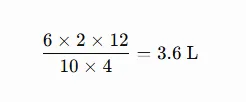
The calculated quantity is 3.6 litres of 4% sodium hypochlorite for the specified 12-hour operating period.
Calculation for 6% Sodium Hypochlorite
Using the same flow rate, dosage, and operating duration:
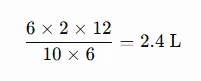
The calculated quantity is 2.4 litres of 6% sodium hypochlorite.
Preparation Table for Sodium Hypochlorite
The following table is based on a dosing pump delivering 3 L/hour at the selected 50% setting, giving the indicated solution volumes.
| Operating time | Total solution | 4% NaOCl | Water for 4% solution | 6% NaOCl | Water for 6% solution |
|---|---|---|---|---|---|
| 6 hours | 18 L | 1.8 L | 16.2 L | 1.2 L | 16.8 L |
| 12 hours | 36 L | 3.6 L | 32.4 L | 2.4 L | 33.6 L |
| 24 hours | 72 L | 7.2 L | 64.8 L | 4.8 L | 67.2 L |
These volumes assume the final solution volume is the stated total and the original concentration values are correct. The actual preparation should follow the approved tank-volume and concentration requirements.
4. Sodium Metabisulphite (SMBS) Solution
Sodium metabisulphite is commonly used to reduce residual chlorine before reverse osmosis or other sensitive downstream treatment stages, where specified in the plant design.
Calculation for SMBS
Given:
- Water flow rate = 4.8 m³/hour
- Required dosage = 6 ppm
- Operating duration = 12 hours
- Chemical purity = 95%
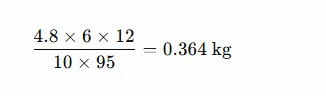
The calculated quantity is approximately 0.36 kg of SMBS.
Preparation Procedure
- Verify the chemical identity and purity against the approved specification.
- Wear suitable chemical-resistant gloves and safety goggles.
- Ensure that the dosing tank is clean and has sufficient capacity.
- Add a suitable quantity of the approved preparation water to the tank.
- Gradually add the calculated quantity of SMBS while mixing.
- Mix until the chemical is fully dissolved.
- Make up to the required final solution volume of 36 litres, if that is the approved batch volume.
- Confirm that the solution is homogeneous and label the tank appropriately.
The source procedure specifies 36 litres of soft water plus the chemical. This would not necessarily produce a final volume of exactly 36 litres. For accurate batch preparation, add water to the required final volume unless the approved SOP explicitly specifies another method.
5. Sodium Hydroxide (NaOH) Solution
Sodium hydroxide may be used for pH adjustment or other approved water treatment applications.
Calculation for NaOH
Given:
- Water flow rate = 4.8 m³/hour
- Required dosage = 7 ppm
- Operating duration = 12 hours
- Chemical purity = 96%
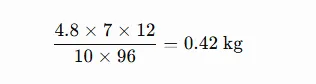
The calculated quantity is 0.42 kg of sodium hydroxide for the specified operating period.
Preparation Procedure
- Confirm the required chemical quantity and final batch volume.
- Wear appropriate PPE, including chemical-resistant gloves and goggles.
- Add an appropriate quantity of water to a compatible dosing tank.
- Slowly add sodium hydroxide to the water while mixing.
- Allow the solution to cool, as dissolution releases heat.
- Add the remaining water to reach the required final volume.
- Mix thoroughly and verify the solution is ready for use under the approved procedure.
Safety precaution: Always add sodium hydroxide to water gradually. Never pour water directly onto solid sodium hydroxide because the heat generated can cause splashing and serious chemical burns.
6. Antiscalant Solution
Antiscalant is used in membrane-based water treatment systems to help reduce the risk of scale formation. The selection and dosage depend on the feed-water characteristics, membrane system design, and chemical manufacturer’s recommendations.
The supplied procedure identifies the antiscalant as SHMP and specifies an available concentration of 68%. Confirm that the chemical actually used at the facility is sodium hexametaphosphate (SHMP) and that the calculation is suitable for its specification.
Calculation for Antiscalant
Given:
- Water flow rate = 4.8 m³/hour
- Required dosage = 6 ppm
- Operating duration = 12 hours
- Available concentration = 68%
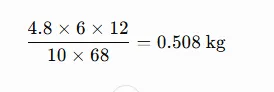
The calculated quantity is approximately 0.51 kg for the specified operating period.
Preparation Procedure
- Verify the approved antiscalant product and required concentration.
- Wear suitable gloves and goggles.
- Add the specified preparation water to a clean dosing tank.
- Measure and add the required chemical quantity.
- Mix thoroughly in accordance with the chemical manufacturer’s instructions.
- Make up to the specified final solution volume.
- Label the solution and confirm the dosing pump is set to the approved delivery rate.
Do not apply this calculation to a different commercial antiscalant without verifying its concentration basis and the manufacturer’s recommended dosing method.
Practical Implementation and Dosing Pump Settings
The supplied procedure specifies a dosing pump with a nominal capacity of 6 litres per hour.
At an assumed 50% output setting, the procedure uses a delivery rate of 3 litres per hour.
| Pump setting | Assumed delivery rate | Solution required for 12 hours |
|---|---|---|
| 50% | 3 L/hour | 36 L |
| 100% | 6 L/hour | 72 L |
These values are theoretical. A pump’s percentage setting does not always correspond linearly to its actual delivery rate. Verify the output by a suitable volumetric or gravimetric calibration method before using these calculations for routine dosing.
Prepare only the quantity required for the approved operating period, taking account of the tank’s usable capacity, solution stability, and the manufacturer’s instructions.
Safety Precautions During Chemical Preparation
Chemical preparation must be performed by trained personnel using the precautions specified in the approved SOP and safety data sheet.
- Wear suitable gloves, safety goggles, and other required PPE.
- Use dedicated, compatible, clearly identified preparation and dosing equipment.
- Avoid skin contact, splashes, and inhalation of chemical vapours or dust.
- Never mix sodium hypochlorite with acids or ammonia-containing chemicals because hazardous gases may be released.
- Add caustic chemicals such as sodium hydroxide slowly to water.
- Follow the manufacturer’s instructions for mixing, storage, and solution stability.
- Keep chemical containers closed when not in use.
- Clean up spills according to the approved spill-response procedure.
- Do not use an unidentified or unlabelled solution.
Common Mistakes to Avoid
- Using the wrong chemical concentration in the calculation.
- Confusing the active ingredient concentration with the concentration of a commercial product.
- Using the nominal pump capacity instead of its verified delivery rate.
- Preparing a batch using the water quantity as though it were the final solution volume.
- Using an incorrect flow rate or operating duration.
- Failing to mix the solution adequately.
- Using an unsuitable preparation liquid or incompatible tank material.
- Failing to record the actual quantity prepared.
- Applying an antiscalant calculation to a different product without verification.
Dosing Solution Preparation Log
| Date | NaOCl (L) | Water for NaOCl (L) | SMBS (kg) | Water for SMBS (L) | NaOH (kg) | Water for NaOH (L) | Antiscalant (kg) | Water for antiscalant (L) | Prepared by | Checked by | Remarks |
|---|---|---|---|---|---|---|---|---|---|---|---|
Use additional fields for the chemical concentration, final batch volume, pump setting, and actual delivery rate where these are required by the approved site procedure.
Acceptance Criteria and Verification
A prepared dosing solution should be considered ready for use only when the applicable requirements of the approved SOP have been met.
The verification should establish that:
- The correct chemical and concentration were used.
- The calculated chemical quantity was independently checked where required.
- The final solution volume is correct.
- The solution has been mixed adequately.
- The dosing tank and associated equipment are suitable for use.
- The dosing pump delivery rate and settings are appropriate.
- Required records and identification labels are complete.
FAQs for Dosing Solution Preparation
1. What is dosing solution preparation in pharmaceuticals?
It is the controlled measurement, dilution, and mixing of treatment chemicals to prepare solutions for use in pharmaceutical water treatment systems.
2. Which chemicals are commonly used in pharmaceutical water treatment?
Depending on the system design, commonly used chemicals include sodium hypochlorite, sodium metabisulphite, sodium hydroxide, and approved antiscalant products.
3. How is the required dosing chemical quantity calculated?
The quantity is estimated from the water flow rate, required dosage, operating duration, and available chemical concentration. The calculation must use consistent units and the correct concentration basis.
4. How much sodium hypochlorite is required for 12 hours of dosing?
In the example provided, 3.6 litres of 4% sodium hypochlorite or 2.4 litres of 6% sodium hypochlorite are calculated for a flow of 6 m³/hour at a dosage of 2 ppm for 12 hours. These values must be verified against actual chemical specifications and system requirements.
5. How much SMBS is required for 12 hours of dosing?
Using the example values of 4.8 m³/hour, 6 ppm, and 95% purity, the calculated requirement is approximately 0.36 kg for 12 hours.
References
Approved pharmaceutical water system design documents and operating procedures.
Read Also
Purified Water System Qualification – Complete Procedure