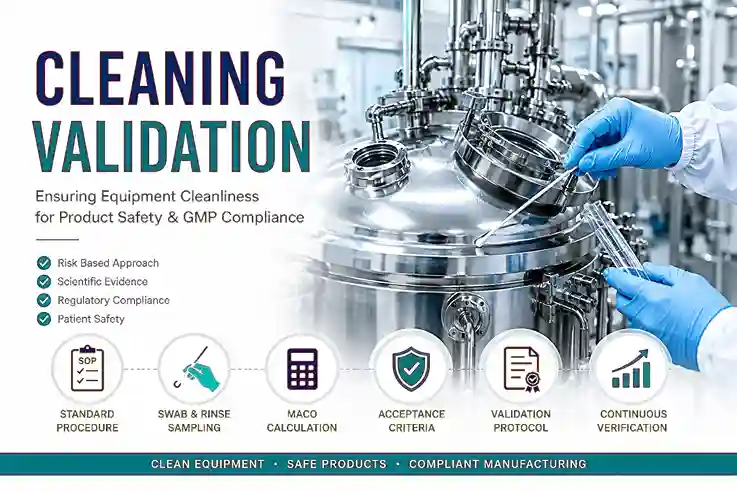
Cleaning Validation in Pharmaceuticals is a critical GMP process that ensures equipment cleanliness, prevents cross-contamination, and maintains product quality and patient safety.
Read Also – Incubator Performance Qualification – Complete Procedure
Purpose of Cleaning Validation in Pharmaceuticals
The purpose of the cleaning validation is to validate the cleaning in pharmaceutical industry.
Scope of Cleaning Validation
The scope of this document is to provide procedure for Cleaning Validation to ensure that the residue of active material of previous product is within specified limit in your company.
Roles and Responsibilities in Cleaning Validation
| Designation | Responsibility |
| Officer/Executive Production/Warehouse | Responsible for ensuring the cleaning of the equipment.Raise intimation of the Cleaning Validation samples. |
| Officer/Executive QA | Responsible for withdraw the cleaning validation samples as per sampling plan.Preparation of Cleaning Validation Protocol. |
| Officer/Executive QC | Responsible for analysis of samples as per the sampling plan.Responsible to provide the solvent for cleaning validation |
| Officer/Executive Micro | Responsible for sampling of micro swab samplesResponsible for microbial analysis. |
Regulatory References
- WHO TRS-937, Annexure 4 Appendix 3
- PDA-29, Points to consider for Cleaning Validation
- ICH Q3 C (R5)
Abbreviation(s) Used:
QA : Quality Assurance
QC : Quality Control
SOP : Standard Operating Procedure
MACO : Maximum Allowable Carryover
NOEAL : No Observable Adverse Effect Level
PDE : Permitted Daily Exposure
HBEL : Health Based Exposure limit
Training Requirements
During cleaning cycle development, Operators plays an important role as they do cleaning & Production officer/Executive and IPQA monitor the cleaning. So, production officer/Executives & operators along with IPQA shall be trained in the requirements of the evolving or existing SOPs. The effective training or qualification of the operators shall be confirmed by monitoring of the equipment after cleaning by production and IPQA. Production officer/Executive and IPQA shall be trained for every cleaning study protocol.
Important Definitions Used in Cleaning Validation
Cleaning Validation: Establishing documented, scientific and risk-based evidence that provides a high degree of assurance that a typical cleaning method or procedure will consistently clean the equipment or a medical device in compliance with its predetermined specifications and quality attributes, taking the patient’s safety into consideration.
Contamination: The product that is adulterated with the residue of the previous batch of the same product in particular equipment is called Contamination or a new product that is adulterated with the residue of raw materials of the previous product is also called Contamination.
Cross-Contamination: A new product that is adulterated with the left behind traces of the previous product in particular equipment is called Cross-Contamination.
Dirty Hold Time: The equipment’s idle time between the end of the last batch and the start of the cleaning process is called Dirty Hold Time.
Clean Hold Time: The equipment’s idle time between the end of the cleaning process and the start of manufacturing is called Clean Hold Time.
MACO (Maximum Allowable Carryover): It is the quantity of the residue from a previous product when carried over into a different product represents a potential harm to the patient.
NOAEL (No Observable Adverse Effect Level): It is the highest tested dose at which no adverse effect is observed.
LD50: Stands for Lethal Dose. It is the amount of a product, given at once, which causes the death of 50% of group of test animal. It is the way measure the short term poisoning potential of the product.
PDE (Permitted Daily Exposure): Represents a substance specific dose that is unlikely to cause an adverse effect if an individual is exposed at or below this dose everyday or lifetime.
ADE (Acceptable Daily Dose): Represent a dose that is unlikely to cause an adverse effect, if an individual is exposed, by any route, at or below this dose every day.
General Procedure for Cleaning Validation in Pharmaceuticals
Cleaning Validation in Pharmaceuticals- Study on Three Consecutive Batches
The cleaning Validation study shall be carried on three consecutive batches of the product (Batch to batch changeover).using the same set of equipment and cleaning procedure.
Equipment and accessories shall be cleaned according to the procedure described in the relevant SOP of cleaning.
After completion of cleaning production Officer/executive shall raise the test request form for swab and rinse. QA personal shall receive the request form and visit the respective area and inspect the equipments visually for cleanliness.
After satisfactory result QA person shall collect the sample from the location/equipment as per the approved protocol.
All the samples along with the TRF shall be sent to the QC for analysis.
Any kind of discrepancies or deviation shall be noted or evaluated for impact on validation study.
Selection of Worst-Case Product in Cleaning Validation in Pharmaceuticals
Bracketing Approach for Cleaning Validation
- Physical characteristic i.e. Solubility, Cleanability
- Therapeutic Dose of the Product
- Concentration of Active Ingredient
- Equipment combination (Equipment Train)
In this bracketing approach cleaning validation of each equipment train shall be performed based upon the worst-case product selected for that equipment train.
Sampling Methods Used in Cleaning Validation in Pharmaceuticals
Considering the design of the equipment used in the plant combination of swab and rinse samples shall be collected for both chemical and microbiological analysis.
For chemical analysis Hi-clean swab shall be used.
QA shall intimate to QC for solvent preparation through the format “Intimation for solvent preparation” for cleaning validation with details such as Product name & no. of swabs required for chemical and microbiological analysis. QC personnel shall check the method of analysis for rinse and swab samples and prepare the Solvent. For microbiological analysis 0.9 % v/v saline solution shall be prepared
After preparation of the solvent and saline solution, QC person shall take the required no. of the swab, solvent, saline solution and handed over to QA.
Surface Area Calculation for Equipment
Calculation of product contact surface area of the individual equipment shall be done according to the SOP “Determination of the Surface Area of equipment”
The Surface area of the equipment shall be recorded.
Selection of Sampling Locations
The product contact part of the equipment, which is hard to clean, shall be selected for sampling.
To determine the sampling location, the following shall be considered.
Equipment characterization for process attributes and geometries.
Material of construction.
To identify the difficult to clean locations.
Procedure for collection of the swab sample
Ensure the equipment is visually clean and dry.
As per the sampling points for equipment, take the swab sticks and give them the numbering as per the location in the sampling protocol for identification.
Firstly take the micro swab from the equipment and then collect the chemical swab from equipment by dipping the swab stick in the solvent and squeeze the swab at the sides of the tube and take the sample within the S.S frame in vertically and horizontally strokes and put it back in the respective test tube.
Sample shall be collected over an area of 10X10 cm surface in vertically and horizontally strokes.
Where the swab sampling in S.S. frame is not feasible (curved surface, corners) approximate not less than 100cm2 area shall be sampled.
Swab sample for chemical analysis shall be taken adjacent to the microbiological sample area to avoid the overlapping.
Procedure for collection of the Rinse Sample
The rinsing activity shall be carried out after the completion of the swab sampling.
For rinse sampling take more than 100ml quantity of the purified water.
Sampling location shall be marked on the bottles equipment wise.
Rinse the specified location of the equipment as per the sampling protocol and collect 100ml of water in transparent bottle.
Send the filled bottle in QC for the analysis.
General aspects to be considered during cleaning validation
Cleaning validation shall be applicable for only product to product change over cleaning.
Cleaning procedure shall be considered to be validated when visual inspection, swab and rinse all complies with the acceptance limit.
If the result of the cleaning validation is out of the acceptance limit, shall be reported as per Handling of Out of specification.
Based on the investigation if failure is justified then SOP of cleaning Validation or cleaning agent shall be revised/modified. Revalidation shall be done with the required modifications.
Selection of Worst Case Location:
The location for sampling shall be defined in the protocol and based on worst case criteria.
- Equipment design and cleaning procedure consideration.
- Hardest to clean component.
- Difficulty in cleaning of product (if applicable).
Calculation of Maximum Allowable Carryover (MACO) – Cleaning Validation in Pharmaceuticals
MACO can be calculated by 4 criteria.
MACO can be calculated by 4 criteria.
- 10 ppm criteria
- Dose criteria
- Toxicity criteria
- Health Based Exposure Limit criteria [which can be an Acceptable Daily Exposure (ADE) or Permitted Daily Exposure (PDE)].
10 ppm Criteria:
MACO = 10 X MBS X SBA/SSA
Where, MBS = Minimum Batch size of next product in Kg
SBA = Surface area of swab
SSA = Surface area of equip.
Dose Criteria:
MACO = TDpre X MBSnxt/SF X LDD
Where, TD = Minimum therapeutic dose of previous product
SF = Safety Factor (0.001)
LDD = Largest Daily Dose
Toxicity Criteria:
MACO = NOEL X MBS/SF X LDD
Where, NOEL = No Observable effect level
MBS = Minimum Batch Size of next batch of next product (in mg)
LDD = Largest Daily Dose (in mg)
SF = Safety Factor
NOEL = LD50 X Avg. body weight of an adult/200
Where 200 is Empirical Constant
LD50 is a lethal dose. (it may vary) if adult avg. Weight is 70kg, and 2000 is constant. For example, if an LD50 of any drug product is 250mg/kg. then NOEL calculation is
NOEL = 250×70/2000= 8.75mg.
Health Based Exposure Limit criteria (PDE)
MACO = PDEPre X MBSnxt X PF/SF X TDDnxt
Where, PDEPre = Permitted Daily Exposure (mg/day)
PF = Purging Factor reflects the ability of a process to reduce the level of the previous product in the downstream synthetic route of the next material (in case the next material is not yet the final API). The default value is “1”
TDD = Minimum therapeutic dose of previous product
SF = Safety factor reflects the effects from the interaction between previous product and next material. In case of no effects from the interaction between previous product and next material can be found the default value is “1”
After establishing MACO (with minimum value) the swab limits and / or rinse limits shall be established with respect to total product contact surface area and total rinse volume respectively.
Swab Limit = MACO X 100/Total product contact surface area in cm2(TS)
Where, 100 is the sampled swab area (10X10) cm2
Rinse Limit = MACO/Total Volume used in Liters
Based on the Bracketing approach the following products shall be selected for Worst case.
Acceptance Criteria for Cleaning Validation
The equipment shall be visually clean.
The maximum allowable carryover shall not exceed more than 10ppm of one product to another product.
Not more than 0.1% of normal therapeutic dose of one product shall appear in the minimum daily dose of next product
Cleaning Validation in Pharmaceuticals–Protocol Requirements
The cleaning validation protocol shall be prepared for execution of cleaning validation study.
The cleaning validation protocol shall be numbered as per the numbering system mentioned in the SOP on Document and Data Control.
The cleaning validation protocol shall include the following, but not limiting to:
- Objective
- Purpose and scope
- Responsibility
- Pre-cleaning validation requirements / Pre-validation checks: Method of cleaning, reason for cleaning, etc. shall be evaluated prior to cleaning validation study.
- Product Description and Process details.
- Details of Equipment used: The entire equipment train used for manufacturing of the product shall be considered.
- Sampling Plan giving details of sample location, volume / number of samples, sampling procedure, sample container and tests to be performed
- Method of analysis: for analyzing the samples collected. The reference of standard testing procedure shall be given. The method employed shall be validated.
- Acceptance criteria.
- Re-validation criteria
Deviations: Observed during the execution of the study shall be recorded and investigated to evaluate the impact of deviation on the validation study.
Cleaning Validation Report
Cleaning Validation Report shall consist of a summary document, in narrative form, which shall briefly describe the activity performed along with the observations recorded.
Cleaning Validation Report: shall be finally approved by Quality Assurance.
Cleaning Revalidation and Verification
Cleaning re-validation shall be performed in following, but not limited to:
- Major change in process /process parameters.
- Change in Cleaning Procedure
- Change in facility
- Change in equipment design.
- Change in Regulatory requirements.
- Change in product formulation
- On appearance of new findings based on current knowledge.
- Introduction of New Manufacturing Equipment.
- In absence of above changes, the periodic revalidation of cleaning process shall be carried out after every 5 years.
- Cleaning verification shall be done on yearly basis for single batch and cleaning verification period shall be counted from the last validation/verification completed.
The number of batches for cleaning validation may be reduced depending upon the criticality of change.
Hold Time Study for Cleaned and Dirty Equipment
The hold time study for cleaned, uncleaned and campaign batch manufacturing shall be carried out on the basis of CEHT protocol and DEHT protocol in order to ascertain the validity period and no. of campaign batches.
Clean Equipment Hold Time (CEHT) & Dirty Equipment Hold Time (DEHT)
Re-verification of established hold time period for CEHT and DEHT shall be carried in case where there is change/modification in cleaning agent and equipment.
The worst case product (Difficult to clean) shall be considered for campaign cleaning study.
The hold time study for the cleaned equipment shall be 48 Hrs. and for uncleaned equipment shall be 24 Hrs.
Ongoing Monitoring of Cleaning Process
Ongoing monitoring shall be performed with defined criteria on validation report to verify / monitor the cleaning process is able to confirm the ongoing appropriateness of the training program as well as operator ability to perform the cleaning process.
Cleaning Validation for Ancillary Equipment
Ancillary equipment is utilized along with the main equipment illustrated in the equipment list Annexure IV. They aid in the manufacturing process in terms of product transfer. Examples of ancillary equipment are SS scoops, SS spatulas, SS beakers / measuring cylinders and SS containers etc. Cleaning validation shall be established for ancillary equipment
Safety Precautions During Cleaning Validation
Before collecting the sample, wear gloves sanitized with 70% IPA.
Equipment shall be checked for visual cleanliness before taking the samples.
Change History
| Effective Date | Nature of revision | Change Control No. | Reason for Revision |