Introduction to Surface Area of Octagonal Blender
The Calculation of surface area of octagonal blender helps determine the total area that may retain product residues after a manufacturing operation. This information can support residue limit calculations, swab sampling plans, rinse sampling strategies, and the scientific justification of cleaning validation studies.
The calculation should be based on actual equipment dimensions, approved drawings, and the equipment manufacturer’s design information. Internal components that come into contact with the product must also be considered.
What is an Octagonal Blender?
An octagonal blender is a pharmaceutical mixing machine consisting of a rotating container with an eight-sided cross-section. It is designed to provide uniform mixing of powders or granules through a tumbling action.
The equipment generally consists of:
- Octagonal mixing chamber
- Internal product-contact walls
- End plates or end sections
- Product charging opening
- Discharge assembly
- Internal baffles, if provided
- Product-contact seals and other components, where applicable
Why is Surface Area Calculation Required?
Surface area calculation is important because the amount of equipment surface exposed to a product influences the planning and evaluation of cleaning validation activities.
The calculated area may be used for:
- Establishing the total product-contact surface area of equipment.
- Supporting maximum allowable carryover (MACO) calculations.
- Converting an equipment-based residue limit into an appropriate surface residue limit.
- Planning the number and location of swab sampling points.
- Supporting rinse sampling strategy development.
- Documenting the scientific basis for cleaning validation calculations.
It is important to understand that surface area alone does not establish whether cleaning is acceptable. The cleaning process must also demonstrate that relevant residues are removed to the approved limits.
Importance in Pharmaceutical Manufacturing and GMP
In pharmaceutical manufacturing, inadequate cleaning can result in product carryover, cross-contamination, or contamination by cleaning agents.
An accurate surface area calculation supports a scientifically justified cleaning validation programme. It also helps ensure that the equipment area used in residue calculations corresponds to the surfaces that can actually come into contact with the product.
Regulatory and GMP Expectations
GMP expectations for cleaning validation focus on demonstrating that cleaning procedures are effective, reproducible, and appropriately documented.
Relevant considerations include:
- Identifying product-contact surfaces and potential residue-retention locations.
- Establishing scientifically justified residue acceptance limits.
- Using suitable sampling and analytical methods.
- Documenting the equipment dimensions and surface area calculations.
- Evaluating difficult-to-clean components and locations.
- Reviewing deviations, calculation errors, and changes to equipment design.
Detailed Procedure – Calculation for Surface Area of Octagonal Blender
1. Collect the Equipment Details
Before starting the calculation, collect the following information:
- Equipment identification number and equipment name.
- Manufacturer and model details.
- Approved general arrangement or fabrication drawing.
- Internal length of the blender.
- Width of each octagonal side or the dimensions required to establish it.
- Dimensions of the end sections.
- Details of charging and discharge openings.
- Details of internal baffles, shafts, seals, or other product-contact parts.
Use internal dimensions for calculating the product-contact area. External dimensions should not be substituted unless the calculation specifically concerns external surfaces.
2. Identify the Product-Contact Surfaces
Review the equipment drawing and identify every surface that may come into contact with the product during normal operation or under justified worst-case conditions.
These surfaces may include:
- Eight internal side panels.
- Internal end surfaces.
- Product-contact portions of the charging opening.
- Discharge valve and associated internal surfaces.
- Internal baffles or other mixing components.
- Exposed product-contact portions of shafts, seals, or fittings.
Do not automatically include every external component. Conversely, do not exclude a component merely because it is small or difficult to access.
The final list should reflect the actual equipment construction.
Practical Example of Surface Area of Octagonal Blender Calculation
The following example demonstrates the calculation for a hypothetical blender. The dimensions are illustrative only and must not be treated as the specifications of a particular machine.
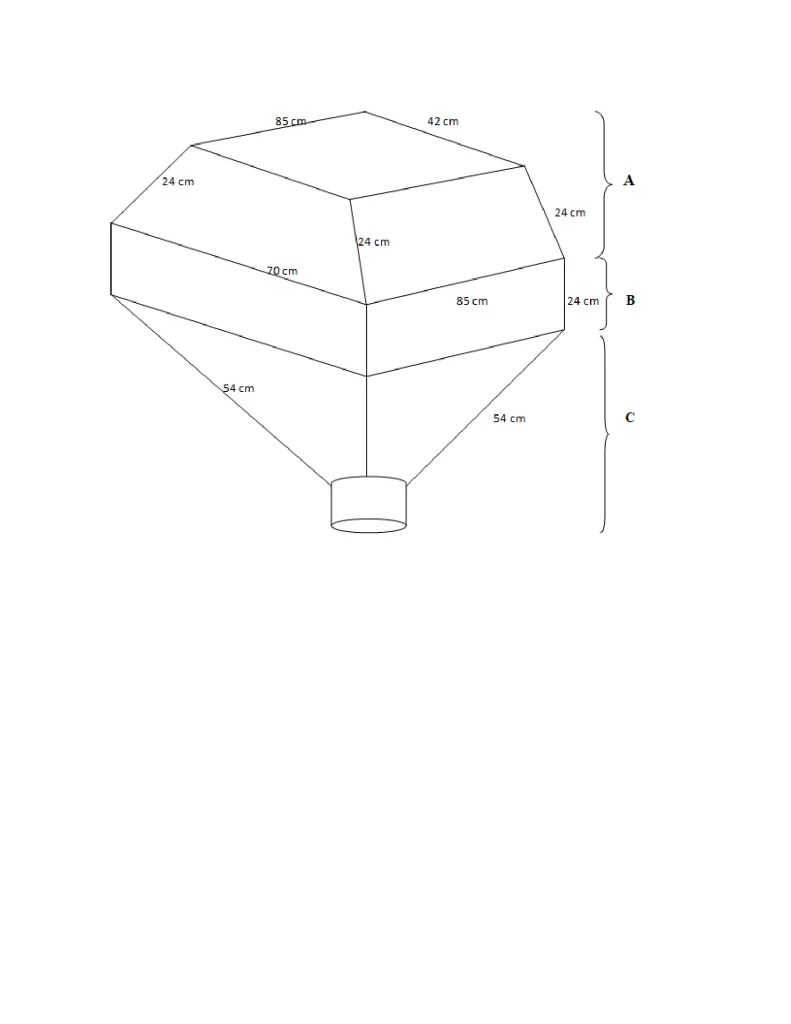
B = 2(LW +LH+WH)
2[(85 X 70) + (85 X 24) + (70 X 24)]
1930 cm2
A = h/3 (A1 + A2 + √ A1 A2)
H = Slanting height
A1 = Lower Base
A2 = Upper Base
24/3 (5950 + 2394 + √5950 X 2394
24/3 (8344 + √14244300
24/3 (8344 + 3774.1)
24/3 X 12118.1
96944.8 cm2
C = C1 + C2
Area of Rectangle = L X W
=85 X 70
=5950 cm2
Area of circle part = π r2
3.14 X (9)2
= 254.34cm2
Frustum Volume = h/3 (Area of Rectangle + Area of Circle + √Area of Rectangle + Area of Circle
= 54/3 (5950 + 254.47 + √5950 X 254.34
54 /3 X 7434.64
Frustum Volume = 133823.52 cm2
Volume of Cylindrical outlet = π r2 h
= 3.14 (9)2 X 15
Volume of Cylindrical outlet = 3815.1 cm2
Total Volume = Frustum Volume + Volume of Cylindrical outlet
Total Volume = 137638.62 cm2
Total Surface Area of Octagonal Blender = 96944.8 + 19340 + 137638.62
Total Surface Area of Octagonal Blender = 253923.42 cm2
Acceptance Criteria and Requirements – Surface Area of Octagonal Blender
There is no universal numerical acceptance criterion for the surface area calculation of every octagonal blender.
The calculation should meet the requirements defined in the approved site procedure or cleaning validation protocol.
Typical expectations include:
- All applicable product-contact surfaces are accounted for.
- Equipment dimensions are traceable to approved drawings or verified measurements.
- Calculations and units are mathematically correct.
- Assumptions and exclusions are documented and justified.
- The total area is independently verified, where required.
Common Mistakes During Surface Area of Octagonal Blender Calculation
Using external dimensions
External dimensions may differ from the actual internal product-contact dimensions. Using the wrong measurements can produce an incorrect area.
Ignoring internal components
Baffles, discharge parts, exposed shafts, and other product-contact surfaces may be overlooked if the calculation is based only on the main blender body.
Applying the octagon formula to an irregular shape
The regular octagon formula is not appropriate for every blender design. Confirm the geometry before using it.
Double-counting surfaces
Overlapping areas, cut-outs, and component interfaces may lead to an inflated result if the same surface is counted more than once.
FAQs to Surface Area of Octagonal Blender
1. Why is surface area calculation required for an octagonal blender?
It establishes the total product-contact area and supports cleaning validation calculations, including appropriate residue limit assessments and sampling strategies.
2. What formula is used to calculate the area of an octagonal blender?
For eight equal rectangular side panels, the lateral area is (8La). For two complete regular octagonal ends, the combined area is (4(1+\sqrt{2})a^2). Additional product-contact surfaces must be calculated separately.
3. Should the external surface area be included?
Generally, the external surface area is excluded when calculating the product-contact area for residue limits. It may be assessed separately if required by the cleaning or contamination-control strategy.
Related Article
Surface Area calculation of Dispensing Utensils